Before we think about what the 2025 offense could look like, we need to wrap our heads around the 2024 offense.
Along with the rest of you lovely people, this time of year leads to me to start thinking of what the 2025 Green Bay Packers are going to look like on the field. My main area of interest is on the offensive side of the ball, so that’s where I always start.
I try to look at how they operated the previous year with the personnel they had, then I look to the updated personnel (players leaving, players acquired through free agency/draft) and see if it still makes sense to operate in that same way or if we may see a shift. To be clear, there are changes every year to some degree. That’s just the nature of the league changing and the offense changing with it. But I’m looking for potential major shifts — I’m not saying these things will happen, but it’s fun to dream.
Today, we’re going to be looking at how the 2024 Packers operated. A little later this week, we’ll use this knowledge and look forward to the 2025 team.
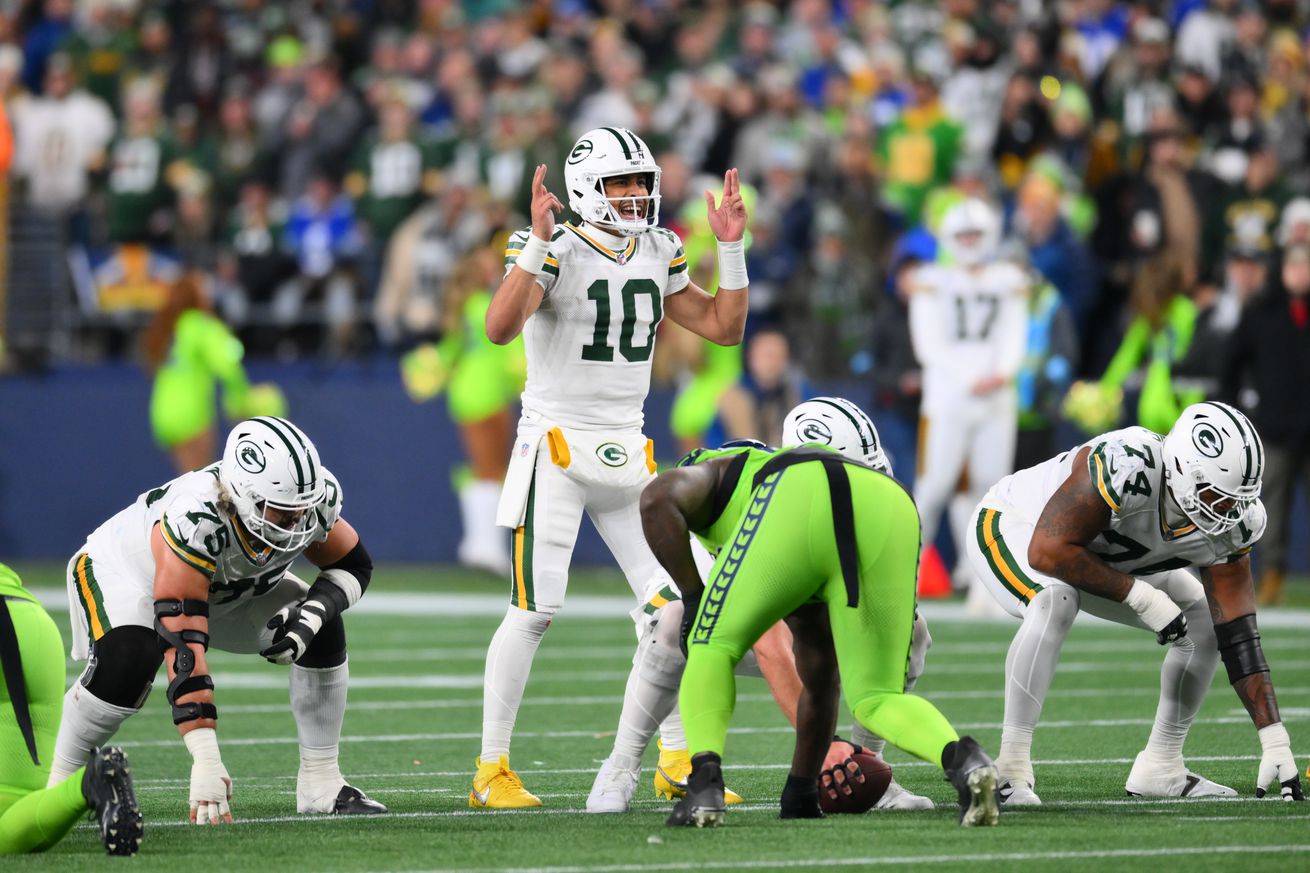
So what were the Packers last year? Per SumerSports, 67.1% of their offense was run out of 11 personnel (1 RB, 1 TE, 3 WR) and 24.6% was run out of 12 personnel (1 RB, 2 TE, 2 WR). They ran a lot of plays from split-gun, but only 5.9% of their snaps were out of 21 personnel (2 RB, 1 TE, 2 WR). A lot of those split-gun formations had a WR or TE in the backfield. I’m sure you can all close your eyes and see Jordan Love in shotgun, with Josh Jacobs on one side and Jayden Reed on the other.
From a formational standpoint, 92.7% of their snaps came from either 2×2 (33.9%), 3×1 (38.5%) or 2×1 (20.4%), per SumerSports (SumerSports actually separates formations like 3×1 and 1×3, but, for the sake of simplicity, I like to bucket those together). Per NFL Pro, They used play action on 25.2% of their passing snaps (12th in the league), which is right in line with where they’ve been under LaFleur (since 2019, they’ve averaged a 26.1% play action rate, ranking an average of 12th in the league).
In general, the Packers like to operate out of condensed formations. They will run plays out of spread, but they tend to operate out of condensed looks more often than not. Even on snaps where they start in spread, they like to motion one of the wide players a little closer to the formation. NFL Next Gen Stats has ways to track formation width, but they don’t publish the data on a regular basis. The latest data I could find was after the 2023 season, and it paints a pretty clear picture:

NFL Next Gen Stats
We get the 2018 data point, which is nice because it shows how the formational approach in offense changed when Matt LaFleur came to Green Bay in 2019. The NFL average has lowered since that time as well, showing that all offenses are playing more condensed than they used to be, but the Packers have stayed ahead of that trend since 2019. I don’t have the data for 2024, but, based on these numbers and the eye test, I feel comfortable saying that the Packers were, once again, ahead of the NFL average in terms of formation width.
With condensed formations being a key part of their scheme, the Packers were one of the most explosive passing offenses in the league (16.5% of their passes went for 15+ yards). That wasn’t an accident and it wasn’t due to Jordan Love going big-play hunting. It was a result of the types of passing plays the Packers were running. By my charting, ~36% of the Packers passing plays this past year were concepts designed to push the ball down the field (Dagger, 4 Verts, All Go RB Seam, High Cross, etc.). Among QBs with at least 385 dropbacks, Jordan Love’s ADOT (Average Depth of Target) of 9.2 was tied for 3rd-highest in the league (just behind Lamar Jackson and Sam Darnold, who both had an ADOT of 9.3).
Those numbers give us a nice base, but what were some changes we saw from 2023 to 2024?
The biggest shift we saw was from their run game, where we saw the Packers use more gap scheme runs than we’ve seen from them in the LaFleur era. Utilizing more pulling linemen is something LaFleur has been trying to get to for years, but, due to limitations on the offensive line, he could never quite get it to work. That all changed in 2024. We saw pullers in Week 1, but LaFleur was able to show off his run-game creativity in the two games Malik Willis was forced to start, working in some Spinner series runs that looked more at home in a single wing offense than a 2024 NFL offense. That approach continued even after Jordan Love came back in (though it was dialed back initially, due to Love’s knee not being in a state where he could pivot well enough to run the offense).
The ability and willingness to pull linemen in the run game helped to level up their play action game as well. Their +0.32 EPA/Play on Play action was good enough to rank 2nd in the league in 2024 (behind the Rams +0.37) and was the Packers’ best performance on play action since their +0.39 EPA/Play season in 2020. Pulling a lineman in the run game allows you to pull a lineman in the play action game, which can help to trigger the linebackers down to the line.
The other big thing we saw was LaFleur’s growing ability to gameplan to specific opponents and adjust in-game. The full arsenal of plays wasn’t on display every game, but LaFleur had an ability to find what worked against an opponent and really lean into those concepts and the variations. LaFleur was able to switch up his approach when he and his staff spotted something that could work (the Leak call against the Jaguars being a prime example).
That’s my somewhat ramshackle look at the operating process of the 2024 Green Bay Packers. It might be a little messy but so is my brain, so I guess that’s to be expected. But now we have our groundwork laid. A little later this week, we’ll look at some of these things (specifically, formations and the new personnel) and what kind of changes we may see in 2025.
Albums listened to: Godspeed You! Black Emperor – F♯ A♯ ∞; Miley Cyrus – Something Beautiful; Alien Boy – You Wanna Fade?; Lilo – Blood Ties