
The Green Bay Packers lost more than just a game when they fell to the Denver Broncos in Week 15. The injury to Micah Parsons has sent Packers fans into full-blown panic mode.
Losing Parsons to a season-ending ACL tear takes away the Packers’ most explosive pass rusher, meaning defensive coordinator Jeff Hafley will see his defensive schemes stress tested for the first time in the Parsons era.
A true moment of reckoning is upon this Packers defense down the stretch, one where structure and adaptability will matter more than raw talent.
Injury To Micah Parsons Will Force DC Jeff Hafley to Adapt
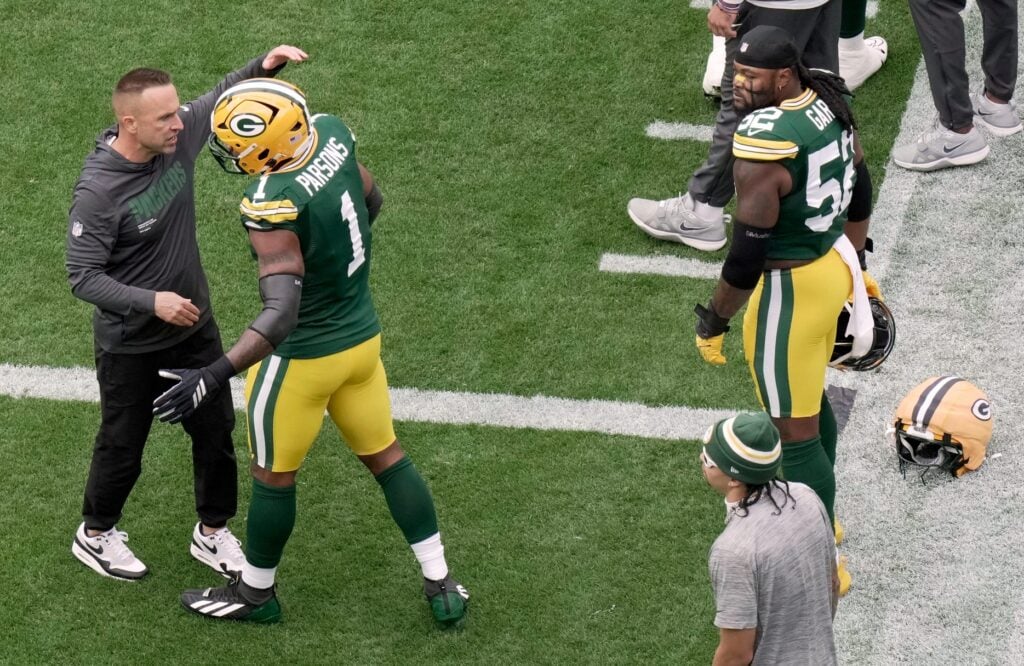
Throughout the 2025 season, the Packers’ defense has been characterized by discipline and effective use of disguise. Hafley has his unit playing in zone coverage on 78.2% of snaps, while relying on man coverage just 17.5% of the time. The zone-heavy philosophy has enabled the secondary to keep plays in front of them while trusting the defensive line to generate consistent pressure, eliminating the need for an all-out blitz. A concept in which the Packers had no issues executing, especially with Parsons sitting near the top of the league in pressures (43) and sacks (12.5).
Parsons’ game-wrecking ability gave Hafley the luxury to blitz at one of the lowest rates in the league, just 19.6%, while still managing pressure on opposing quarterbacks at a consistent rate. The Packers generate pressure at a 38.1% rate, which is comfortably in the top half of the league. That balance of constant pressure without blitzing has often worked for Hafley, but it comes with flaws that could be exposed with Parsons sidelined for the season.
When the defensive line has failed to get home, we have seen times where Hafley’s heavy zone looks have been exposed. Quarterbacks have been able to find soft spots and extend plays, forcing the secondary to hold up longer than designed. Broncos quarterback Bo Nix had success this way in their past meeting, throwing for 302 yards and four touchdowns, with plenty of that coming in the second half after Parsons went down. Parsons was frequently able to erase those issues by collapsing pockets before pass catchers could even get to their spots. Now, that margin for error shrinks significantly.
That reality frames the most significant question about Hafley’s schemes following the injury: Will he double down on the identity that has produced efficiency thus far, or does he become more aggressive to compensate for the loss of a two-time All-Pro?
Manufacturing Disruption Without Parsons
The easy answer might be to tick up the rate at which the Packers blitz, but that is far from an automatic solution. Forcing constant blitzes comes with a high level of risk, especially for a defense built on zone integrity. Sending extra rushers can compromise spacing and put defensive backs in difficult leverage situations. This could turn out to be a dangerous trade-off for a secondary that has already shown vulnerability when protection breaks down late. To add to that point, if the extra rushers still cannot replicate the effect and success Parsons had when rushing the quarterbacks, we could see Hafley’s unit take a real step back in effectiveness.
This being Hafley’s second year as DC in Green Bay, but only his first with Parsons on the roster, means he has indeed begun dusting off his playbook from the pre-Parsons era, especially digging deep into the pressure section. While we won’t see exactly what Hafley decides to change in his schemes until Saturday night, when the Packers travel to Chicago to play the NFC North-leading Bears in Week 16, an answer could lie in what Hafley has already been so great at achieving: simulated pressures.
Simulated pressures have been an area Hafley has leaned on all season, and now it may be time to expand. This will be a time when second-level defenders become essential. Linebackers will be depended on more than ever, and that is where Edgerrin Cooper enters the conversation as a potential X-Factor.
Expanding The Workload of Edgerrin Cooper
Cooper, who is a second-year linebacker out of Texas A&M, has been one of the Packers’ most effective and electric defenders this season. His ability to get downhill, blow up plays, and stop running backs in their tracks is arguably second to none on this team. But now it is time to get one of the Packers’ brightest stars more involved in all facets of the defensive game plan.
Cooper has accumulated an impressive 105 combined tackles this season, an increase from his total of 87 last season in the same 14 games. Although Cooper is a first-time starter with the Packers this season, his tackles for loss (4) and QB hits (3) are down from last year, when he recorded 13 TFLs and seven QB hits. This does not indicate a loss of production, as he is making tackles at a career-high rate, but rather shows a change in how he is utilized, rarely rushing to the backfield.
Cooper should not be used to replicate Parsons by having him line up on the line or at the edge. However, his value lies in how he can blur protection rules. Whether through delayed blitzes, interior pressure looks, or pre-snap movement that causes offensive lines to hesitate, Cooper’s speed, energy, and elite tackling consistency give Hafley flexibility without fully abandoning zone principles.
If Hafley and the Packers can create confusion and, more importantly, generate pressure without substantially increasing blitz volume, the defense can maintain its identity while making the necessary adjustments to adapt and thus preserve its effectiveness. If this approach fails to create sustainable pressure, Hafley may be forced to send extra personnel and accept the risks that follow.
Using Cooper in the backfield isn’t guaranteed to be a hit. Still, with injuries piling up defensively, the potential benefit outweighs the risk of giving more opportunities to one of the Packers’ promising young players.
The post Injury to Packers’ Micah Parsons Will Test Jeff Hafley’s Defense appeared first on Last Word on NFL.